
Flat Roof Repair in Manitowoc, WI
Walk any older Manitowoc or Two Rivers neighborhood and you'll count flat roofs: a back addition, a porch with a deck on top, an attached garage, a sunroom tacked onto a lake cottage, a dormer with a walk-out. These small flat sections leak far more than their size suggests. Snow and wind-blown drifts collect where they meet the house, the flashing into the wall is often a strip of tar from forty years ago, and plenty of them were covered with roll roofing or a single rubber sheet and never touched again. Many shingle crews pass on them. We don't. We find the actual entry point, repair it with the same material the roof is made of, and tell you plainly when a small section would cost less to replace than to keep patching.
What's included
- Porch, addition, garage and dormer flat roof leak repair
- EPDM (rubber) seam, flashing and puncture repair
- Modified bitumen and roll-roofing repair
- Wall and siding flashing where the flat roof meets the house
- Leaks where a flat section meets a shingled slope
- Low spots corrected with tapered insulation or re-sloping
- Scupper, gutter and downspout repair
- Skylight and hatch curb flashing
- Small flat roof replacement when patching no longer makes sense
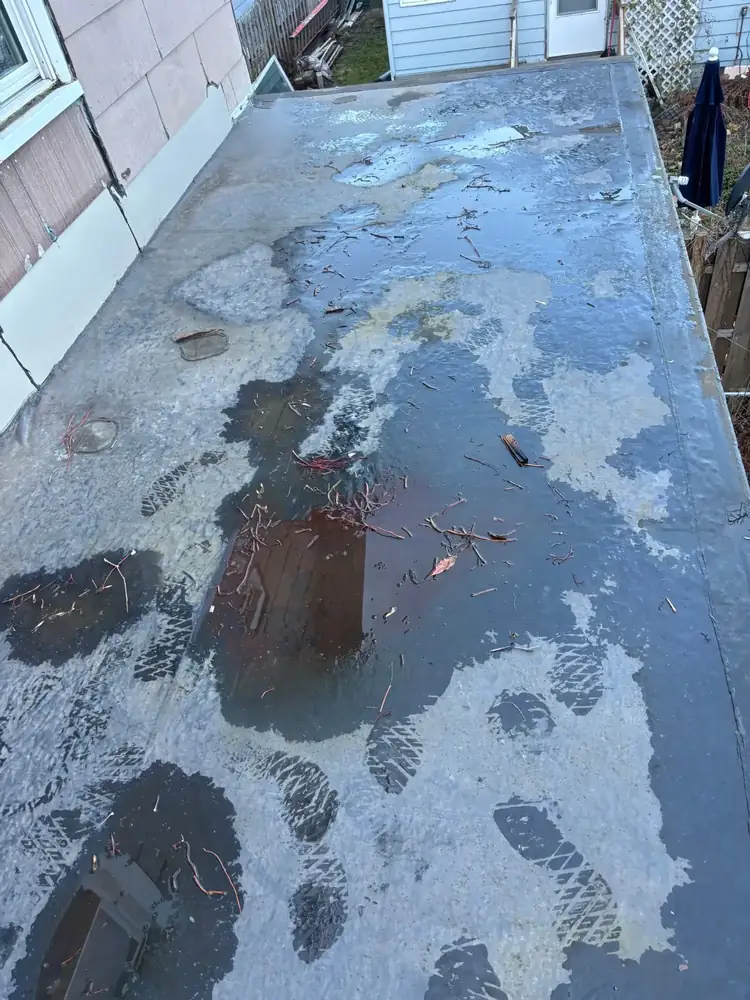
Sound like your roof?
- A ceiling stain under a porch roof or back addition
- Water inside every spring when the snow goes
- Cracked, blistered or alligatored roll roofing
- Black tar smeared over the same corner more than once
- Rubber pulling away from the wall or the drip edge
Leaking right now? Protect the inside first
Move what can get wet, kill power to wet fixtures and catch the water. Keep people off the roof in wind, dark or ice, then request service.
Related services
Flat Roof Repair — FAQs
Most residential flat roof repairs, such as a seam, a wall flashing or a puncture on a porch, garage or addition, run about $300–$1,800. Replacing a small flat section outright is often $2,500–$7,000, depending on size, material and how much rotted decking turns up.
Small flat roofs usually leak where they meet the house: the flashing into the siding or brick, or the joint with the shingled slope above. Wind off the lake drifts snow into exactly that corner, and ice forms there first.
Only when the load gets heavy, like deep wet snow or snow capped with ice, and only with a plastic shovel or roof rake, leaving a couple of inches so the membrane isn’t cut. See snow load on flat roofs.
As a stopgap in an emergency, maybe. It dries, cracks and lets go within a season or two, and every layer of it makes the real repair harder. A proper patch uses the roof’s own material bonded or welded to clean membrane.
Yes. Low-slope sections on lake homes, cottages and boathouses along the shore are common, usually EPDM rubber or modified bitumen. Mention access (stairs, bluffs, narrow lots) when you send the request.